.jpg)
Tell us more about you
We primarily work with businesses and public sector organizations. Share your email with us to receive product updates, client case studies, and information about upcoming installations in your area.


Thank you! Your submission has been received!
Oops! Something went wrong while submitting the form.
By subscribing to our newsletter, you agree to our Privacy Policy and consent to receive updates from us. You can unsubscribe at any time.
Relying on bottled water for your team of 10 or more? We’ve got a better solution. Fill out the form and our sales team will be in touch within one business day!
Thank you! Your submission has been received!
Oops! Something went wrong while submitting the form.
Off-Grid Water: How Decentralized Solutions Power Remote Environments
In areas where traditional water systems can’t reach the people, off-grid solutions are paving the way for drinking water access.

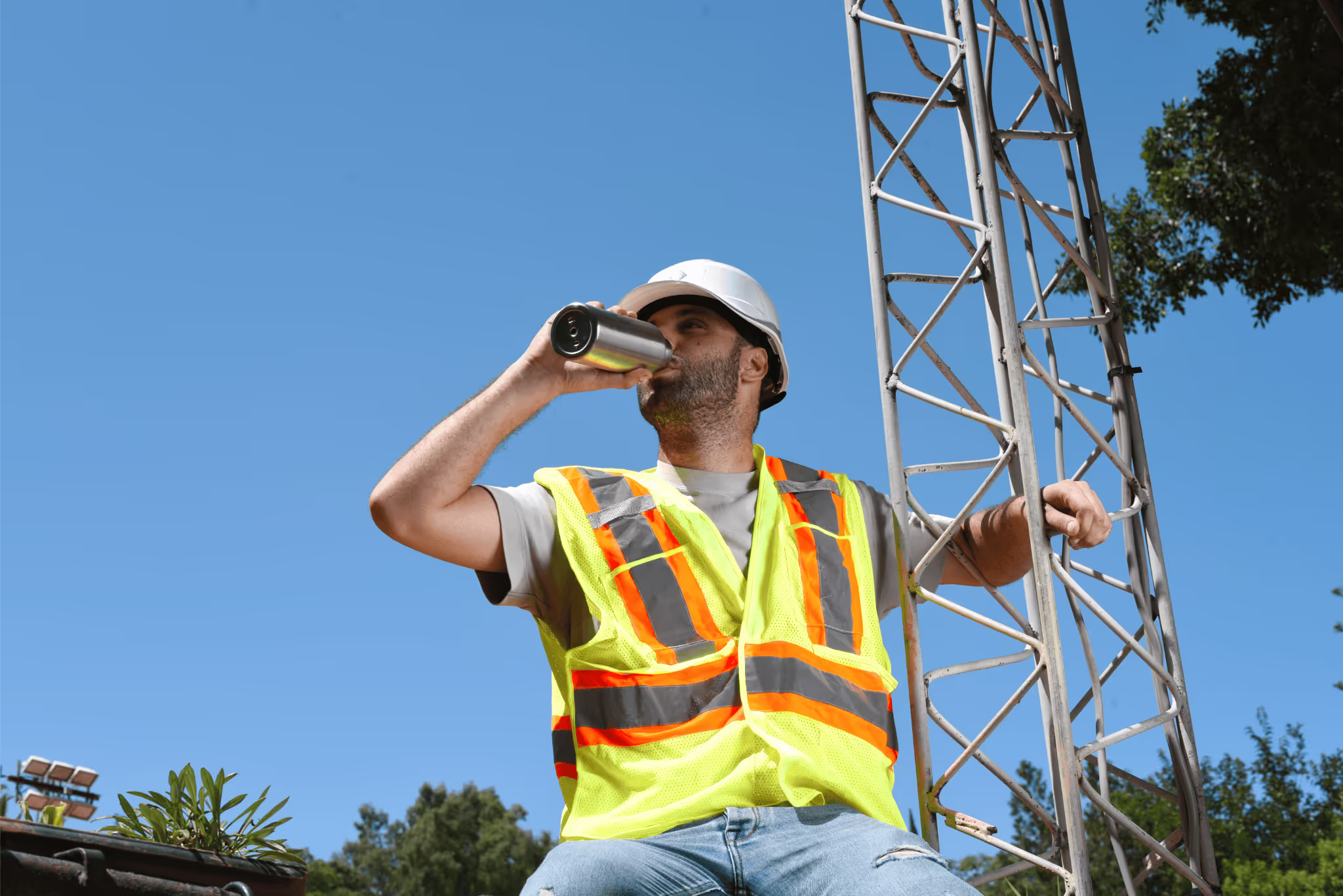
Have you ever wondered how worksites and facilities that operate away from centralized water systems get water for their staff? Think off-grid construction sites, mining areas, rural airports and locations within the site, seaports, or eco-tourism lodges far from any town.
These sites often resort to trucking in water, or rely on plastic bottled water for their staff and visitors. The result is a mountain of plastic waste (85% of plastic bottles aren’t recycled 1 and end up in landfills) and a huge carbon footprint due to heavy transportation vehicles. This is not only costly and inefficient, but also environmentally unsustainable.
In recent years, decentralized off-grid water access has emerged as a sustainable, cost-effective alternative as global demand for water surges. Off-grid water solutions can bring clean drinking water anywhere without needing pipelines or complex logistics. This massively cuts down plastic waste and CO₂ emissions while ensuring that even remote communities or operations have reliable water access. In an age of intensifying climate events and infrastructure challenges, decentralized water systems like water-from-air generators, are the way forward.
What Are Decentralized (Off-Grid) Water Solutions?
In simple terms, a decentralized water system is a self-contained water solution that sources, purifies, and delivers drinking water on-site, independent of a centralized utility. In contrast to the traditional model, decentralized systems work right where you need the water.2
Off-grid water systems come in various forms. For example, some homes use rainwater harvesting (collecting and filtering rain for use) or greywater recycling (treating household wash water for secondary uses). Compact filtration and treatment units can purify water from nearby wells or rivers, at the point of use.
An atmospheric water generator (AWG), or air-to-water generator, is another off-grid, decentralized water solution. These devices pull in the humidity from air and cool it to draw out water droplets through condensation. The extracted water is then filtered and mineralized to ensure that it’s safe and healthy to drink. The entire process happens on-site, giving even locations with no natural water source (or very poor water quality) the ability to make their own water.
Benefits of Off-Grid Water Systems
Decentralized, off-grid water solutions offer a host of benefits that address the pains of conventional water supply. Some key advantages are:
1. Accessible Water Anywhere
If you’re in a remote or off-grid location, a decentralized system can provide water on the spot without the need for connecting to municipal pipes or arranging deliveries. In humanitarian emergencies or disaster zones where infrastructure is down, portable off-grid water systems can be rapidly deployed to give people drinking water when conventional systems fail.3
2. Sustainable and Eco-Friendly
Off-grid water systems can be designed to run on renewable energy while reducing waste generation. Many atmospheric water generators can be powered by solar panels, meaning they pull water from the air using clean energy from the sun. By replacing bottled water or water trucking, these solutions slash plastic pollution and carbon emissions.
3. Scalability and Flexibility
Off-grid water solutions are highly scalable. You can start with one unit and add more as needed. A single atmospheric water generator might supply a household or a work crew; if you need more water for a village or a larger site, you can deploy multiple units or larger-capacity machines. This means it is easy to scale up or down quickly, unlike building a big treatment plant, which is a huge one-time project.
4. Independence and Empowerment
With an off-grid system, users have direct control over their water production and quality. This reduces reliance on external water delivery or aging infrastructure.
Sustainable Technology and Water Quality
With the rise of off-grid solutions, a common question arises: are they truly sustainable, and is the water safe to drink?” In general, off-grid systems are built as a sustainable alternative to plastic bottled water, or complex logistics. The quality, however, depends on the treatment and filtration process of the system. The water also needs to be rigorously tested to ensure it is fit for human consumption.
Off-grid water systems: A sustainable alternative
Decentralized water systems generally produce minimal waste. Air-to-water generators like Kumulus, for instance, produce drinking water and only expel drier air. Though the filter and mineralizer tubes have to be replaced periodically, the impact is much smaller when compared to the heaps of waste generated by single-use plastic bottles. Similarly, rainwater systems bypass the need for pumping groundwater and don’t generate waste beyond filter backwash.
Many decentralized water systems also integrate renewable energy. For example, Kumulus AWGs can be solar-powered, enabling completely off-grid, zero-emission operation in sunny regions. As these technologies improve, their carbon footprint per liter of water also reduces.
All things considered, decentralized water tech aligns well with sustainability goals: they are capable of using renewable energy, providing safe drinking water, and cutting reliance on plastic bottles and trucking logistics.
Drinking water quality of off-grid systems
When it comes to quality, is it really safe to drink water that’s been captured from the air, or collected from your roof? With the proper treatment, absolutely! Most off grid drinking water systems include robust filtration and purification stages to ensure the output water meets or exceeds standard drinking water quality.
For example, Kumulus’ water from air solutions utilize a multi-filtration system with four filters: 1. Particle filter, 2. Carbon filter, 3. Resin filter, and 4. UV filter. The filtered water is further passed through a mineralizer to add a balanced taste, enhance water quality, and provide nutritional benefits. This water then undergoes rigorous testing (with almost 7,000 tests!!) to ensure that it is fit for human consumption. The AWG device also undergoes regular maintenance by Kumulus’ technicians.
Discover our solutions
So yes, it is safe to drink water from off-grid systems– as long as the water is purified, tested to meet health guidelines, and the system is regularly maintained and serviced.
Kumulus: Making Water from Air for a Sustainable Future
Inspired by the dew at dawn in the arid desert of Tunisia, Kumulus was born from a simple observation in nature – and so, sustainability is at the core of our mission. The result is a solution that creates clean drinking water on location, addressing the issue of inaccessible and unsustainable water in remote places.
So how exactly does the Kumulus solution work? In simple terms, it draws in humid ambient air, stores it in a reservoir, and cools it until the water condenses. The collected water is then thoroughly purified, before going through a mineralizer. The purified, mineralized water is stored in an internal tank, ready for drinking via a tap.
Read more: How Our Technology Works
What makes Kumulus so attractive for off-grid use is its practical performance. A single Kumulus solution can produce about 20 to 40 liters of clean water per day on average, depending on humidity and temperature conditions. These solutions can run on normal electrical supply or be hooked up to solar panels for true off-grid operation. Importantly, they don’t require any existing water source – no well, no river, not even rain – which means they can be deployed literally anywhere you have air and some power. They’re designed to work in every weather condition; whether it’s a humid coastal area or a dry inland region. As long as there’s some humidity, the system is capable of extracting water from air.
From rural schools to marine ports, Kumulus' solutions provide a local source of safe drinking water without the need for any grid connection or water delivery. This has important implications: for a school in a remote village, it means children have clean water on-site rather than having to fetch it from miles away; for an off-grid site with no water source, this means no reliance on single-use plastic bottled water or trucking logistics. Every liter made on-site is a liter not brought in by a truck, which is both, economically and environmentally, a big win.
Case Study: Orange Fondation x Kumulus Water
.avif)
Looking ahead, the next step in Kumulus’ objectives is scaling up the technology. We are currently developing a new high-capacity line called “Kumulus Titan” aimed at industrial and community-scale use, as well as a possible solution in emergencies. These units would produce significantly more water per day, which could reach up to 2,000 liters under optimal conditions. This would be enough to support large industrial sites, off-grid and remote construction sites, or as a rapid deployment to communities affected by natural disasters or other crises. It’s part of the vision to make off-grid water not just a niche solution, but a mainstream one for decentralized communities and any place grappling with water scarcity.
Empowering a Water-Secure Future
The ever-rising demand for water and the challenges of access in remote areas call for innovative solutions. Off-grid, decentralized water systems like Kumulus’ atmospheric water generators are proving that we can bring water security anywhere, from rural villages to off-grid construction sites, while staying sustainable.
Read more: Our Sustainability Commitment
If you operate a remote construction site, run a humanitarian project in a rural area, or are part of a community with limited water access, now is the time to consider off-grid water solutions. By adopting systems like the Kumulus air-to-water generator, you can ensure a continuous supply of safe drinking water for your people while dramatically cutting down on waste and emissions. It’s not just a smart business or operational move – it’s a step toward a more sustainable and self-reliant future.
Ready to explore off-grid water for your needs? Learn more about how Kumulus and our atmospheric water generators can deliver clean water anywhere!
- 1 Eurostat (2026). Hourly Labour Costs in the European Union (EU). [online] Europa.eu. Available at: https://ec.europa.eu/eurostat/statistics-explained/index.php?fbclid=IwAR0Lte90UgA3duT8qeuOywbq1Z5eRvl-Btm8tKhZJtZH3oQDqTBylxa9SZs&title=Hourly_labour_costs [Accessed 8 Apr. 2026]
- 2 Wittbrodt, M.T. And Millard-Stafford, M. (2018). Dehydration Impairs Cognitive Performance. Medicine & Science in Sports & Exercise, 50(11), pp.2360–2368. doi:https://doi.org/10.1249/mss.0000000000001682.
- 3 Wolford, B. (2019). How Does Dehydration Impact Workplace safety? [online] Safeopedia. Available at: https://www.safeopedia.com/how-does-dehydration-impact-workplace-safety/7/8074.
- 4 Adan, A. (2012). Cognitive Performance and Dehydration. Journal of the American College of Nutrition, [online] 31(2), pp.71–78. doi:https://doi.org/10.1080/07315724.2012.10720011.
- 5 Ganio, M.S., Armstrong, L.E., Casa, D.J., McDermott, B.P., Lee, E.C., Yamamoto, L.M., Marzano, S., Lopez, R.M., Jimenez, L., Le Bellego, L., Chevillotte, E. and Lieberman, H.R. (2011). Mild dehydration impairs cognitive performance and mood of men. The British journal of nutrition, [online] 106(10), pp.1535–43. doi:https://doi.org/10.1017/S0007114511002005.
- 6 Riebl, S.K. and Davy, B.M. (2013). The Hydration Equation: Update on Water Balance and Cognitive Performance. ACSM’s health & fitness journal, [online] 17(6), pp.21–28. doi:https://doi.org/10.1249/FIT.0b013e3182a9570f.