.jpg)
Tell us more about you
We primarily work with businesses and public sector organizations. Share your email with us to receive product updates, client case studies, and information about upcoming installations in your area.

Thank you! Your submission has been received!
Oops! Something went wrong while submitting the form.
By subscribing to our newsletter, you agree to our Privacy Policy and consent to receive updates from us. You can unsubscribe at any time.
Relying on bottled water for your team of 10 or more? We’ve got a better solution. Fill out the form and our sales team will be in touch within one business day!
Thank you! Your submission has been received!
Oops! Something went wrong while submitting the form.
Dehydration is a Hidden (Financial) Cost on Your Off-Grid Sites – Here's Why
Dehydration can silently drain your team's productivity and finances, here's what you can do about it.
%20(1).avif)
When site managers think about workplace or on-site productivity, they tend to focus on the usual subjects: scheduling, equipment, and logistics. Unsurprisingly, water rarely makes the list. But the science is clear: clean, accessible drinking water is the single most attainable performance lever on any construction, industrial, or off-grid site, not a new piece of software or a smarter workflow.
Drinking water at off-grid sites can often creep up as a hidden cost for both, worker health and well-being, as well as their productivity levels. And even a “small” productivity dip can be costly, quite literally. Eurostat estimates labor costs in construction at ~€34.4/hour in the euro area (2025) (comprising of the employer cost, not just wages) 1. On an 8-hour shift, that’s roughly €275 per worker per day.
What dehydration actually does to the brain
The human body is roughly 60% water, but did you know that the brain is also around 75% water? That proportion matters because the moment your water level starts to drop, even slightly, your brain feels it first. Research published in multiple peer-reviewed journals shows that a body water loss of 1 to 2% can measurably impair cognitive performance2. This includes everything from your concentration and reaction times to short-term memory and information retention.
To put that in concrete terms: a 1% drop in hydration can cause a 12% decrease in worker productivity. At 3-4% dehydration, that figure more than doubles to a 25% decline. And the tricky part is that you don't feel thirsty until you're already around 1-2% dehydrated. By the time a worker reaches for a bottle, they're already operating at a deficit3.
Using the productivity impacts mentioned above that’s:
- 12% productivity loss on a €275/day worker ≈ €33 lost per worker per day and
- 25% productivity loss on a €275/day worker ≈ €69 lost per worker per day
On a 50-person site, that’s roughly €1,650/day lost at a 12% decrease in productivity, and €3,440/day lost at a 25% decline.
Studies have also found that dehydration increases feelings of fatigue, tension, and anxiety, while reducing the perceived effort required to complete tasks feels higher. This means that your team works harder in their heads just to maintain the same output. On a long shift in the sun, that hidden dehydration tax compounds fast.
Why workers on off-grid sites are especially at risk
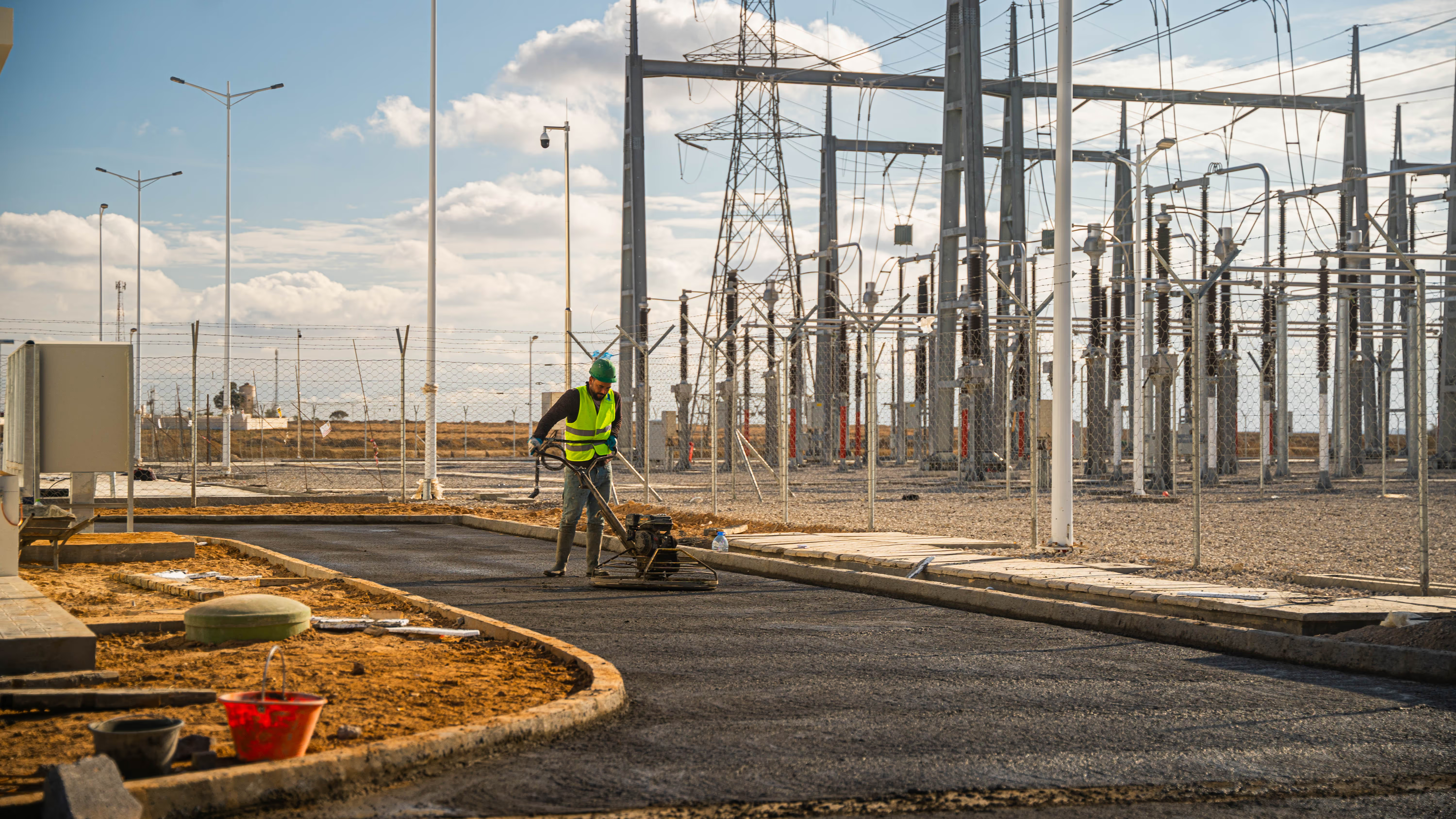
In a standard office, the barriers to hydration are generally habitual. However, on a construction site, an industrial facility, or a remote off-grid location, the barriers can also be structural.
Water isn't always necessarily nearby. Carrying bottles from a central point is inconvenient, so people don't do it consistently. In hot climates, think a Tunisian industrial plant in July, or a Saudi construction site during summer, sweat rates are high and fluid loss is rapid. Physical labor accelerates this further. Workers are losing water through both exertion and heat, often without realizing how quickly it adds up.
The real benefits of a hydrated team
It's easy to think of hydration as a "nice to have." But multiple studies confirm that it should be considered a critical part of any workplace, whether off-grid or not. Some listed benefits are:
1. Sharper focus and fewer mistakes
Dehydration causes mental fog - that heavy, sluggish feeling where concentration slips and errors creep in. On a site where precision matters (operating machinery, following safety procedures, reading plans), mental clarity isn't optional. Keeping your team hydrated keeps their attention dialed in.4
2. Better mood and smoother teamwork
Research found that even mild dehydration increases feelings of tension, anxiety, and fatigue. Conversely, well-hydrated workers tend to be more patient, more communicative, and easier to work with. On a high-pressure site, that interpersonal friction, or the absence of it, has a real impact on how efficiently a team functions together.5
3. Fewer sick days and faster recovery
Water supports immune function, regulates body temperature, and helps muscles recover after physical exertion. Workers who stay consistently hydrated are less likely to suffer from heat-related illness, headaches, or the general run-down feeling that leads to days off. For project managers watching a timeline, that reliability matters.
4. Sustained energy throughout the shift
Water is essential for cellular energy production. When workers are dehydrated, their cells can't generate energy that efficiently, leading to the afternoon slump that hits harder than it should. Proper hydration helps maintain consistent energy levels from morning briefing to end of day shift.6
Practical strategies for better hydration at off-grid sites
Knowing the problem is one thing, but building a system around it is another challenge. Here's what can actually work:
Make water the path of least resistance
The most effective hydration intervention is proximity, not a poster or a memo. It’s quite simple - when clean water is within arm's reach, people drink it. When it requires a detour, they don't. Placing water points at regular intervals across the site, near workstations and break areas can significantly increase water intake.
Set a rhythm, not just a rule
Rather than leaving hydration to individual discretion, build it into the day. Water as part of the morning briefing, during the mid-morning coffee break, at lunch, and mid-afternoon creates a predictable cadence that becomes a habit over time.
Account for the climate
Standard hydration guidance (around 2 liters per day) is designed for moderate conditions. In hot, humid, or physically demanding environments, requirements are significantly higher; it can reach up to 3-4 liters or more. Factor this into your site planning, especially during summer months or in arid regions.
Don't rely solely on thirst
Train your team to understand that thirst is a lagging indicator. By the time they feel it, they're already behind. Mood shifts and loss of concentration can easily become indicators of dehydration.
Water autonomy can solve the water access problem at off-grid sites
On many off-grid, construction, and industrial sites, access to clean, safe drinking water is genuinely difficult. Bottled water deliveries are expensive, logistically complex, and generate significant plastic waste. Trucked-in water can be inconsistent in quality and supply. Tap infrastructure simply doesn't exist.
This is the gap that Kumulus is designed to fill. Our atmospheric water generators directly turn air into mineralized drinking water, entirely on-site, with no pipes, no deliveries, and no plastic bottles required. Our solutions are also versatile, as they can be powered through the grid or by solar energy. The autonomy is exactly what’s needed in the kinds of environments where water access has traditionally been a headache: remote construction sites, industrial facilities, off-grid communities.
Discover our solutions
Take the case of Groupe ADP’s TAV Airports in Tunisia.
With close to 800 employees across large, open spaces, access to the water network wasn’t always practical - long walking distances, relying on plastic bottled water, and the water becoming warm over time.
Our mission was simple: keep teams reliably hydrated on site, while reducing environmental impact and the logistical stress of bottled water supply.
The solution: 12 Eekan units and 12 Kaia water fountains, deployed where people actually work. Today, employees have a reliable source of fresh water every day, with fewer single-use bottles and a smoother day-to-day operation.
Whether your site is on islands in the Indian Ocean, Saudi or Tunisian deserts, or a rural stretch of Europe, Kumulus can provide your team with reliable, safe water from air, where and when they need it.
Read more: How Off-grid Water Solutions Power Remote Environments
.avif)
Hydration as a performance standard
The conversation around workforce wellbeing has evolved significantly over the past decade. Mental health, ergonomics, and work-life balance are all important. But sometimes the most fundamental elements get overlooked precisely because they seem too simple.
Water is simple, and its impact on performance, safety, and morale is often underestimated by employers.
If you're managing a team in a demanding environment, the question worth asking isn't "do we have water on site?" It's "do we have enough clean water, in the right places, for every worker, every day?" The answer to that question has a measurable effect on everything from the quality of work to the safety record to the team's state of mind at end of shift.
Start with water. Everything else follows.
- 1 Eurostat (2026). Hourly Labour Costs in the European Union (EU). [online] Europa.eu. Available at: https://ec.europa.eu/eurostat/statistics-explained/index.php?fbclid=IwAR0Lte90UgA3duT8qeuOywbq1Z5eRvl-Btm8tKhZJtZH3oQDqTBylxa9SZs&title=Hourly_labour_costs [Accessed 8 Apr. 2026]
- 2 Wittbrodt, M.T. And Millard-Stafford, M. (2018). Dehydration Impairs Cognitive Performance. Medicine & Science in Sports & Exercise, 50(11), pp.2360–2368. doi:https://doi.org/10.1249/mss.0000000000001682.
- 3 Wolford, B. (2019). How Does Dehydration Impact Workplace safety? [online] Safeopedia. Available at: https://www.safeopedia.com/how-does-dehydration-impact-workplace-safety/7/8074.
- 4 Adan, A. (2012). Cognitive Performance and Dehydration. Journal of the American College of Nutrition, [online] 31(2), pp.71–78. doi:https://doi.org/10.1080/07315724.2012.10720011.
- 5 Ganio, M.S., Armstrong, L.E., Casa, D.J., McDermott, B.P., Lee, E.C., Yamamoto, L.M., Marzano, S., Lopez, R.M., Jimenez, L., Le Bellego, L., Chevillotte, E. and Lieberman, H.R. (2011). Mild dehydration impairs cognitive performance and mood of men. The British journal of nutrition, [online] 106(10), pp.1535–43. doi:https://doi.org/10.1017/S0007114511002005.
- 6 Riebl, S.K. and Davy, B.M. (2013). The Hydration Equation: Update on Water Balance and Cognitive Performance. ACSM’s health & fitness journal, [online] 17(6), pp.21–28. doi:https://doi.org/10.1249/FIT.0b013e3182a9570f.